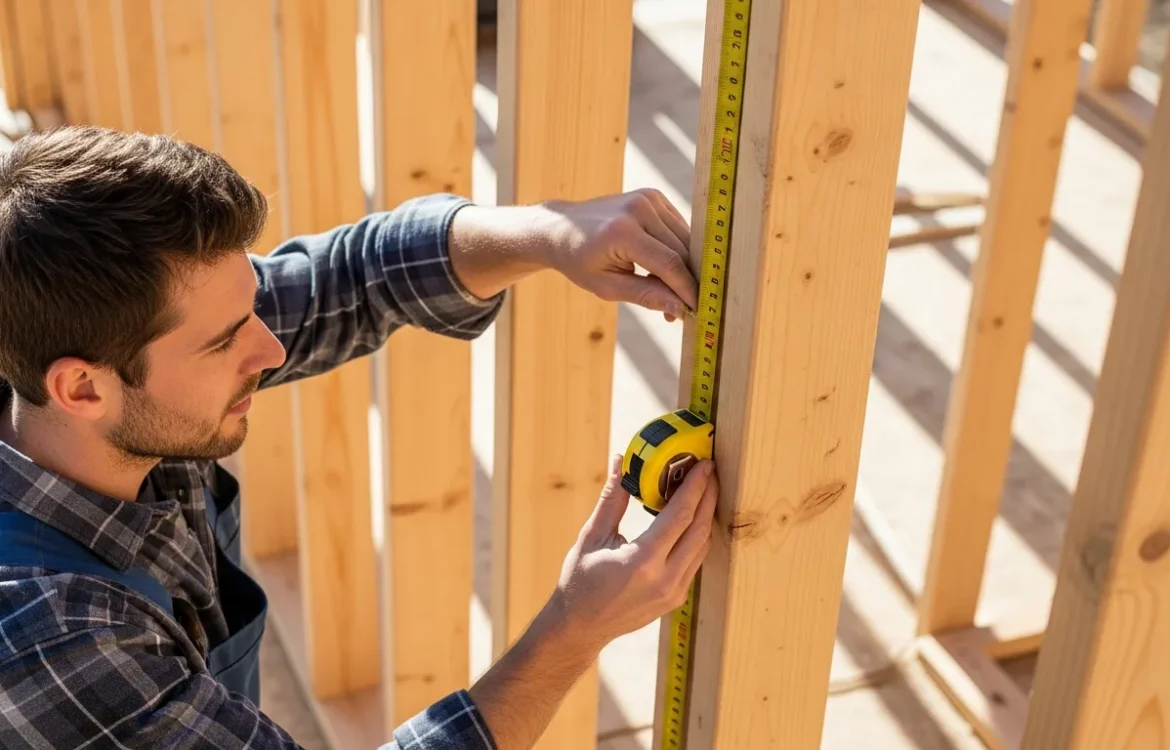
How Far Apart Are Wall Studs? The Standard Spacing Guide
The Standard Spacing for Residential Wall Studs
A man needs to know exactly what is behind his drywall before he starts drilling holes for a heavy mirror or a new shelving unit. In the vast majority of modern homes and apartments, wall studs are 16 inches apart. This measurement is taken “on center,” meaning from the middle of one vertical timber to the middle of the next.
This 16-inch standard exists for a specific reason: it provides structural integrity while perfectly accommodating standard 4×8 sheets of drywall or plywood. When a man understands this layout, he can predict where his support beams are located with high accuracy, even without a battery-powered sensor in his hand.
When Studs Are Spaced 24 Inches Apart
While 16 inches is the norm, he might encounter 24-inch spacing in certain scenarios. This wider gap is common in non-load-bearing interior walls or in modern “advanced framing” techniques designed to improve energy efficiency by reducing the amount of lumber used.
If he is living in a newer building or a utility-focused space like a garage, he should check for this wider interval. Knowing how far apart are wall studs in his specific unit prevents the frustration of a “missed” drill bit and a crumbling hole in the plaster.
How to Locate Studs Without a Stud Finder
A man does not always have a stud finder in his toolbox, but he can still find his mark using logic and a few simple tricks. Most builders place studs next to electrical boxes. If he looks at a light switch or a power outlet, he can safely assume a stud is running vertically on one side of that box.
- The Tap Test: He can knock firmly on the wall. A hollow sound indicates empty space, while a solid, muffled thud suggests he has found the timber.
- The Flashlight Trick: By holding a light flush against the wall, he can look for small dimples or imperfections in the paint. These often reveal where drywall screws were driven into the stud.
- The Corner Measurement: Since studs usually start at the corner of a room, he can measure 16 inches out from the corner to find his first point of support.
Why Precision Matters for Heavy Mounting
If he plans on hanging a TV on a wall in an apartment, guessing is not an option. A 65-inch television or a loaded bookshelf can easily rip through drywall if it is only held by plastic anchors. He must ensure that at least two of his mounting screws are driven directly into the center of the wood.
When he finds the first stud, he should mark it lightly with a pencil. From there, he can measure exactly 16 inches to the left or right to find the next one. He should always double-check by poking a small finishing nail into the wall to confirm he feels the resistance of the wood before committing to a large drill bit.
Frequently Asked Questions
Are studs always 16 inches apart?
No. While 16 inches is the standard for load-bearing walls, some interior partitions use 24-inch spacing. In older homes built before standardized codes, spacing can be irregular.
How do I know if my walls are 16 or 24 inches apart?
He can measure the distance between two known studs (like those next to an outlet) or use a tape measure from the corner of the room to see which increment aligns with a solid thud when tapping.
Can I hang a heavy TV without a stud?
It is highly discouraged. While heavy-duty toggle bolts exist, they rely on the strength of the drywall. For a man’s expensive electronics, securing the bracket to the actual wall studs is the only way to guarantee it won’t fall.
Do windows and doors change stud spacing?
Yes. Builders use “king studs” and “jack studs” to frame openings. This usually breaks the 16-inch rhythm, so he should be careful when measuring near window frames or door jambs.