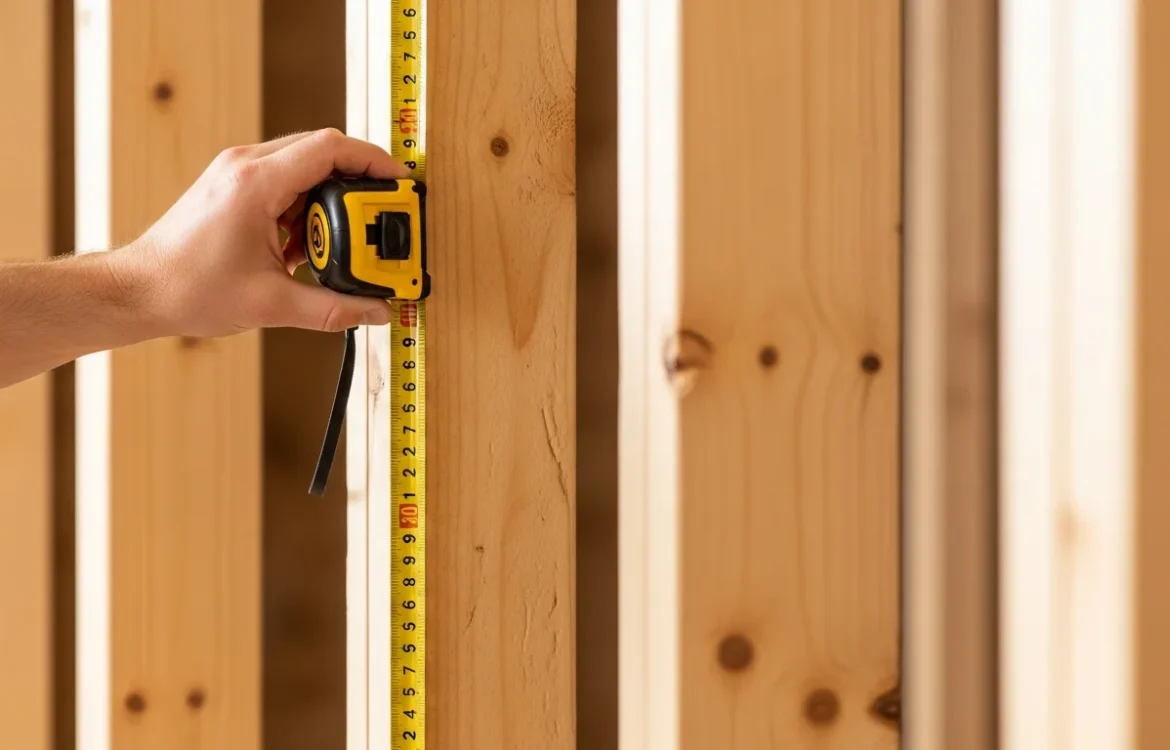
How Many Inches Apart Are Wall Studs? The Standard Spacing Guide
The Standard Spacing: 16 Inches on Center
When a man stands in front of a finished wall with a heavy television mount in his hand, he needs to know exactly what is happening behind the drywall. In the vast majority of modern residential construction, wall studs are spaced 16 inches apart. This measurement is taken “on center,” meaning the distance is calculated from the center of one vertical stud to the center of the next.
This 16-inch standard exists for a specific reason: it aligns perfectly with standard building materials. Since plywood, OSB, and drywall sheets are typically 8 feet long, a 16-inch interval ensures that the edges of these sheets always land directly over a solid wooden support. This creates a rigid, structurally sound frame that can support the weight of the building and anything he decides to hang on the walls.
Why Some Walls Use 24-Inch Spacing
While 16 inches is the gold standard, he may encounter walls where the studs are 24 inches apart. This is more common in older homes, detached garages, or in modern “advanced framing” techniques designed to increase energy efficiency by using less wood and more insulation.
If he is working on a non-load-bearing interior wall—one that doesn’t support the weight of the roof or the floor above—the builder might have opted for this wider spacing to save on material costs. Before he starts drilling, he should always verify the spacing by measuring from a corner or using a reliable stud finder to avoid missing the mark.
Pro Tips for Finding Studs Without a Tool
He doesn’t always need a high-end electronic sensor to find a stud. If he knows the tricks of the trade, he can locate the framing using visual cues and basic logic. When hanging a TV on a wall in his apartment, he can use these manual methods to confirm his measurements:
- Check the Trim: Look at the baseboards or crown molding. Carpenters usually nail these into the studs. If he sees a small filled nail hole or a slight dimple in the wood, there is almost certainly a stud directly behind it.
- The Flashlight Trick: He can hold a flashlight flush against the wall and shine the beam across the surface. This side-lighting reveals imperfections in the drywall, such as “mudded” joints or fastener heads that indicate a stud’s location.
- The Knock Test: Tapping on the wall with his knuckle is a classic move. A hollow sound means he’s between studs, while a solid, dull thud indicates he’s found the wood.
- Locate the Outlets: Electrical boxes are almost always nailed to the side of a stud. By removing the plastic cover plate, he can often see which side the stud is on and measure 16 inches from that point.
Dealing with Corners and Windows
The 16-inch rule often breaks down when it hits a corner, a window, or a door frame. At these points, builders add extra studs (known as king studs and jack studs) to provide additional structural support. If he is measuring from a corner, he should keep in mind that the first stud might be slightly less than 16 inches away because the measurement starts from the exterior edge of the corner post rather than the center.
If he finds that the studs are awkwardly placed for his project, or if his lease prevents him from drilling large holes, he might consider apartment wall decoration that is damage-free to avoid losing his security deposit. However, for heavy items like cabinetry or large mirrors, hitting the center of that 1.5-inch thick piece of lumber is non-negotiable for safety.
The Importance of Accuracy
Missing a stud by even half an inch can lead to a catastrophic failure. Drywall alone cannot support significant weight; the screws will eventually pull through the gypsum core under tension. He should always mark both edges of the stud to find the exact center. Since a standard 2×4 stud is actually 1.5 inches wide, finding that center point ensures the screw has maximum grip and won’t splinter the edge of the wood.
Frequently Asked Questions
Are studs always 16 inches apart?
No, while 16 inches is the most common spacing, some walls use 24-inch spacing, especially in newer energy-efficient homes or non-load-bearing interior walls.
How do I know if my studs are 16 or 24 inches apart?
He can check by measuring from a corner or an outlet. If he finds a stud at 16 inches, that is the likely pattern. If he hits nothing until the 24-inch mark, the wall uses wider spacing.
Can I hang a heavy mirror between studs?
It is not recommended. For heavy items, he should always anchor into at least one stud. If the placement doesn’t align, he can use a toggle bolt, but a stud is always the most secure option.
Do horizontal studs exist?
Yes, these are called “fire blocks.” They are horizontal pieces of wood installed between vertical studs to slow the spread of fire. They are usually found halfway up the wall height.