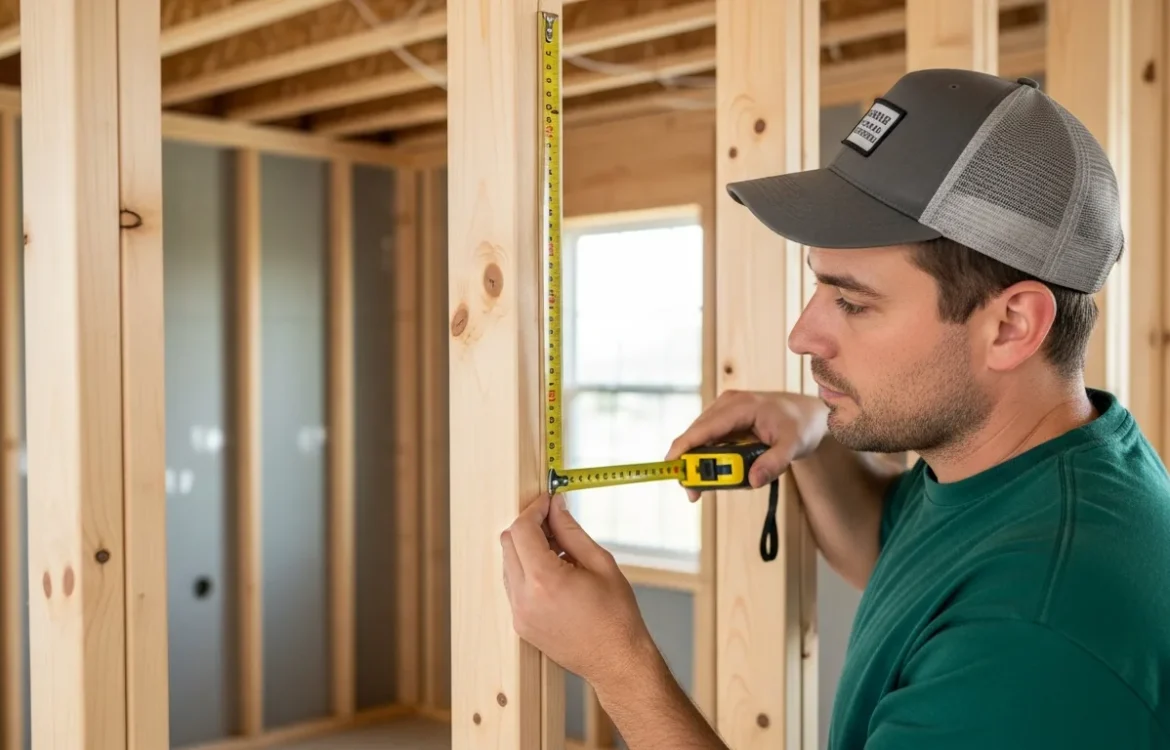
How Far Apart Are Wall Studs? A Guide to Standard Spacing
The Standard Distance Between Wall Studs
Whether a man is mounting a heavy flat-screen television or installing a new set of floating shelves, knowing exactly where the structural support lies behind his drywall is critical. In most modern residential construction, the standard distance between wall studs is 16 inches on center. This means the measurement is taken from the center of one vertical stud to the center of the next.
While 16 inches is the gold standard, some structures utilize 24-inch spacing. This is often found in older homes, non-load-bearing walls, or utility buildings where the structural requirements are less stringent. Understanding these measurements allows a DIYer to plan his projects with precision and ensure that whatever he hangs stays securely on the wall.
What Does “On Center” Mean?
When a builder discusses stud spacing, he almost always uses the term “on center” (O.C.). This is a vital distinction for anyone trying to locate a stud. If he measures from the edge of one stud to the edge of the next, the distance will be shorter because of the width of the wood itself (typically 1.5 inches for a standard 2×4). By measuring from the center point, he ensures that his fasteners hit the thickest part of the timber, providing maximum grip and weight capacity.
Why 16 Inches is the Industry Standard
The 16-inch rule isn’t arbitrary; it is designed to work perfectly with standard building materials. Most sheets of drywall, plywood, and OSB come in 4-foot by 8-foot dimensions. A 48-inch wide sheet of drywall fits perfectly over studs spaced at 16 inches, as 48 is divisible by 16. This allows a craftsman to secure the edges of the sheet directly into the center of a stud, creating a flush and durable surface.
When he is implementing creative apartment interior design ideas, he must respect these structural realities to avoid damaging the wall or having his decor fall. Heavy mirrors or art pieces should always be anchored into these vertical supports whenever possible.
How to Find Studs Without a Stud Finder
If a man doesn’t have an electronic stud finder in his toolbox, he can still locate the framing using a few professional tricks. Here are the most reliable methods:
- Check the Outlets: Electrical boxes for switches and outlets are almost always nailed to the side of a stud. By removing the cover plate, he can often see which side the stud is on.
- The Knock Test: Tapping on the wall can reveal a lot. A hollow sound indicates the space between studs, while a solid, muffled thud suggests he is directly over the wood.
- Measure from the Corner: Since studs are laid out from the corner of a room, measuring in 16-inch increments from a corner often reveals their location.
- Look for Trim Nails: Check the baseboards or crown molding. Builders often nail these into the studs, and even though the holes are filled with putty, a keen eye can sometimes spot the slight indentations.
Once he identifies the general location, he can use a small finishing nail to probe the wall behind a baseboard to confirm the exact center before he begins mounting cool things in his apartment that require heavy-duty support.
Variations in Stud Spacing
In some specialized cases, such as in very old homes or specific commercial builds, he might encounter irregular spacing. If a wall has been modified or if he is working near a window or door, the studs will be placed closer together to provide extra framing for the opening. These are often called “king studs” and “jack studs.” He should always double-check his measurements before drilling, especially in kitchens or bathrooms where plumbing and electrical lines are frequently tucked alongside the framing.
Frequently Asked Questions
Are all wall studs 16 inches apart?
No. While 16 inches is the most common spacing for load-bearing walls, 24-inch spacing is also a recognized building standard, particularly in newer energy-efficient homes or interior partition walls that do not support the roof’s weight.
How do I know if my studs are 16 or 24 inches apart?
A man can determine the spacing by using a stud finder or by measuring from a corner. If he finds a stud at 16 inches, the rest follow that pattern. If the first one he finds is at 24 inches, the wall likely uses the wider spacing standard.
Can I hang a TV on a wall with 24-inch stud spacing?
Yes, but he must ensure the TV mount is wide enough to span the 24-inch gap. If the mount is only designed for 16-inch studs, he may need to attach a piece of 3/4-inch plywood to the studs first, then mount the TV bracket to the plywood.
Are studs always made of wood?
In most residential homes, studs are wood 2x4s or 2x6s. However, in many high-rise apartments and commercial buildings, he will find metal (steel) studs instead. Metal studs require special toggle bolts or self-tapping screws for mounting.