
How Much Does It Cost to Build a House in 2026? Complete Price Breakdown & Guide
For millions of renters facing continuous lease renewals and escalating rent, building a custom home represents the ultimate milestone: long-term housing stability, personalized layouts, and direct equity growth. However, moving from tenant to homebuilder requires understanding realistic market pricing before committing capital.
In 2026, the national average cost to build a single-family home is approximately $323,000 for construction alone, with most standard builds ranging between $140,000 and $530,000+ depending on size, finish level, and location. When factoring in land, utility connections, and municipal permits, all-in costs typically land between $440,000 and $580,000.
This guide provides realistic cost-per-square-foot benchmarks, a phase-by-phase budget breakdown, hidden soft expenses, and an objective comparison of building versus renting in today’s economy.
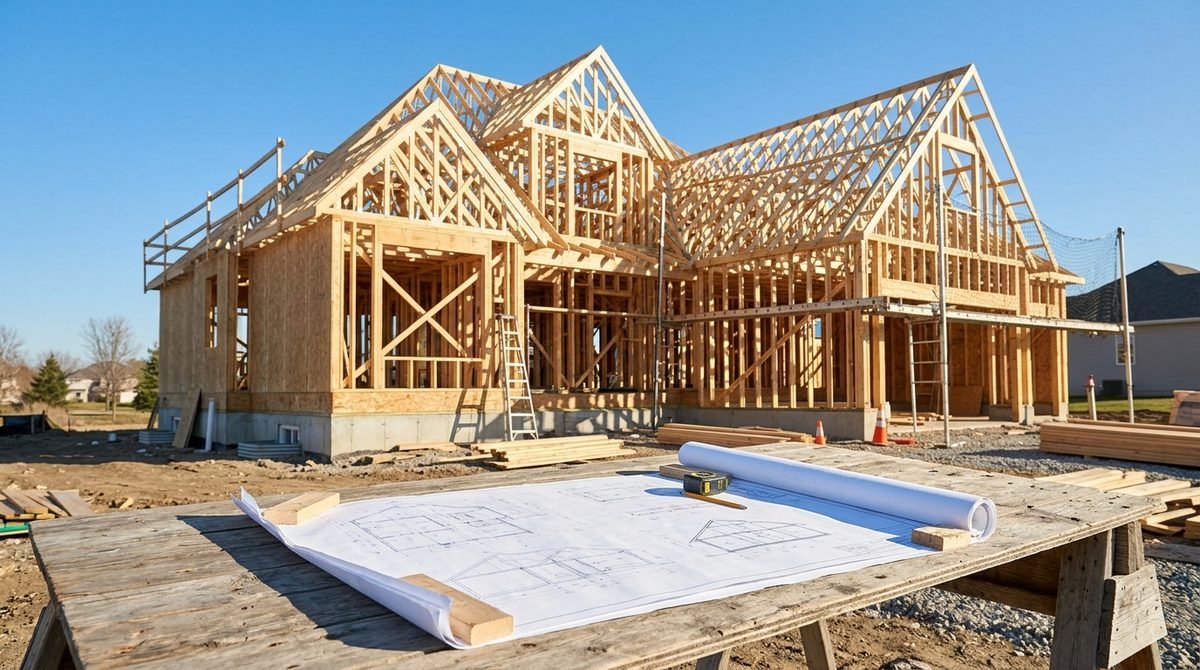
Average Cost to Build a House by Square Footage
Residential construction pricing is universally evaluated on a cost per square foot basis. In 2026, standard builder-grade construction averages between $150 and $250 per square foot. Economy modular or production builds with simplified rooflines can drop to $120 to $160 per square foot, while custom luxury residences featuring architectural millwork and imported finishes reach $350 to $500+ per square foot in high-demand markets.
Due to economies of scale, larger homes frequently post lower per-square-foot rates because fixed mechanical infrastructure—such as HVAC units, utility hookups, and electrical panels—is amortized over greater floor area. Conversely, smaller footprints have higher per-foot averages despite lower overall project checks.
| Home Size (Sq Ft) | Typical Layout | Economy ($120–$160/sq ft) | Standard ($170–$250/sq ft) | Custom ($280–$450+/sq ft) |
|---|---|---|---|---|
| 1,000 sq ft | 2-Bed ADU / Cottage | $120,000 – $160,000 | $170,000 – $250,000 | $280,000 – $450,000+ |
| 1,500 sq ft | 3-Bed, 2-Bath Ranch | $180,000 – $240,000 | $255,000 – $375,000 | $420,000 – $675,000+ |
| 2,000 sq ft | Standard Suburban Home | $240,000 – $320,000 | $340,000 – $500,000 | $560,000 – $900,000+ |
| 2,500 sq ft | 4-Bed, 2.5-Bath Two-Story | $300,000 – $400,000 | $425,000 – $625,000 | $700,000 – $1,125,000+ |
| 3,500 sq ft | Executive Estate | $420,000 – $560,000 | $595,000 – $875,000 | $980,000 – $1,575,000+ |
If you are planning an efficient, manageable footprint or an income-generating backyard rental, explore our detailed layout guide on 2 bedroom house building plans for space optimization and budget estimates.
Phase-by-Phase Construction Budget Breakdown
Understanding where capital goes helps prevent budget creep. Data from the National Association of Home Builders (NAHB) and the U.S. Census Bureau highlights five major structural cost centers:
- Site Work & Foundation (12%): Excavation, grading, footings, and concrete. Slabs on grade run $7–$11 per square foot, while crawlspaces cost $10–$16, and full poured basements average $25–$40 per square foot.
- Framing & Trusses (21%): Structural lumber, wall studs, floor joists, sheathing, and roof trusses. Framing is the largest single material and carpentry expense.
- Mechanical Rough-Ins (17%): Essential infrastructure completed before drywall, including high-efficiency heat pumps, ductwork, PEX plumbing runs, and 200-amp electrical panels.
- Exterior Finishes (15%): Weatherproofing envelope comprising roofing shingles, moisture wraps, fiber-cement or vinyl siding, gutters, and double-glazed windows.
- Interior Finishes (27%): Drywall installation, paint, insulation, kitchen cabinetry, quartz or granite counters, interior doors, and hardwood or luxury vinyl tile (LVT) flooring.
- Final Site Completion (8%): Driveways, walkway flatwork, basic grading, cleanup, and final municipal code inspections.

| Construction Phase | Share of Budget | Estimated Cost (2,000 Sq Ft Home / $340,000 Build) |
|---|---|---|
| Site Work & Foundation | 12% | $40,800 |
| Framing & Roof Trusses | 21% | $71,400 |
| Exterior Finishes (Roof, Siding, Windows) | 15% | $51,000 |
| Major Systems (Plumbing, Electrical, HVAC) | 17% | $57,800 |
| Interior Finishes (Drywall, Cabinets, Flooring) | 27% | $91,800 |
| Final Site Work & Cleanup | 8% | $27,200 |
| Total Hard Construction Cost | 100% | $340,000 |
Critical Soft Costs and Hidden Expenses to Budget For
Many first-time builders evaluate only hard construction expenses and are caught off guard by secondary soft costs:
Land Acquisition & Surveys: The lot generally accounts for 20% to 30% of total project investment. Topographical surveys and soil percolation tests add $2,500 to $5,000.
Permits & Impact Fees: Municipal plan reviews, engineering stamps, and school/road impact fees range from $5,000 to $22,000 depending on county regulations.
Utility Connections: Hooking up public water, sewer, and grid electricity—or installing a septic field and private well—runs $8,000 to $30,000.
General Contractor Markup: Builders charge 15% to 25% overhead and profit margin to coordinate trade crews, manage schedules, and warranty the build.
Financing Costs: Construction loans charge 1% to 2% higher interest than conventional mortgages, adding $10,000 to $25,000 in carrying charges over a 9- to 14-month schedule.
Building vs. Buying vs. Renting: Which Makes Sense in 2026?
With rental prices holding near historic highs—as documented in our data on how much a two-bedroom apartment costs in the US—choosing between renting, buying, and building comes down to your personal horizon.
Renting is Best When: You plan to move within 3 to 5 years, lack substantial cash reserves for a 20% down payment and 15% contingency fund, or live in congested urban cores where vacant parcels are nonexistent.
Buying an Existing Home is Best When: You need immediate occupancy without navigating a 10-month construction process, or prefer established neighborhoods with mature trees and proven resale records.
Building New is Best When: You own or can buy affordable suburban/rural land, desire superior thermal efficiency that lowers monthly bills by 30% to 40%, and want zero maintenance surprises backed by 10-year builder structural warranties.

4 Practical Ways to Lower Your Construction Budget
- Choose a Simple Geometric Footprint: Square or rectangular footprints with simple gable roofs minimize framing complexity, structural waste, and labor expenses by up to 15%.
- Align Plumbing Wet Walls: Stacking bathrooms and positioning laundry rooms adjacent to kitchens shortens pipe runs and saves substantial plumbing labor.
- Select Durable Mid-Tier Finishes: Standard quartz surfaces and durable luxury vinyl plank (LVP) deliver high-end aesthetics without custom stone or hardwood markups.
- Maintain a Strict 15% Contingency Fund: Weather delays and unexpected subgrade conditions are inevitable. A dedicated contingency fund prevents project stalls.
Frequently Asked Questions (FAQ)
What is the cheapest style of house to construct?
A single-story ranch or rectangular two-story modular home with a standard gable roof is the most economical design to build due to simplified framing and lower labor hours.
Does the quoted cost per square foot include land?
No. Standard published construction rates cover only structural materials, labor, and builder fees. Land purchase, utility hookups, and grading are budgeted separately.
How long does ground-up home construction take?
Production tract homes take 6 to 9 months, while custom single-family homes require 10 to 15 months from municipal permit issuance to final move-in.
Summary: Taking Your First Step
Building a home offers unparalleled customization and equity creation. By budgeting for both hard and soft costs and partnering with reputable builders, you can navigate your construction project smoothly. To plan your next steps, visit our Costs & Budgeting section for comprehensive financial calculators and home guides.