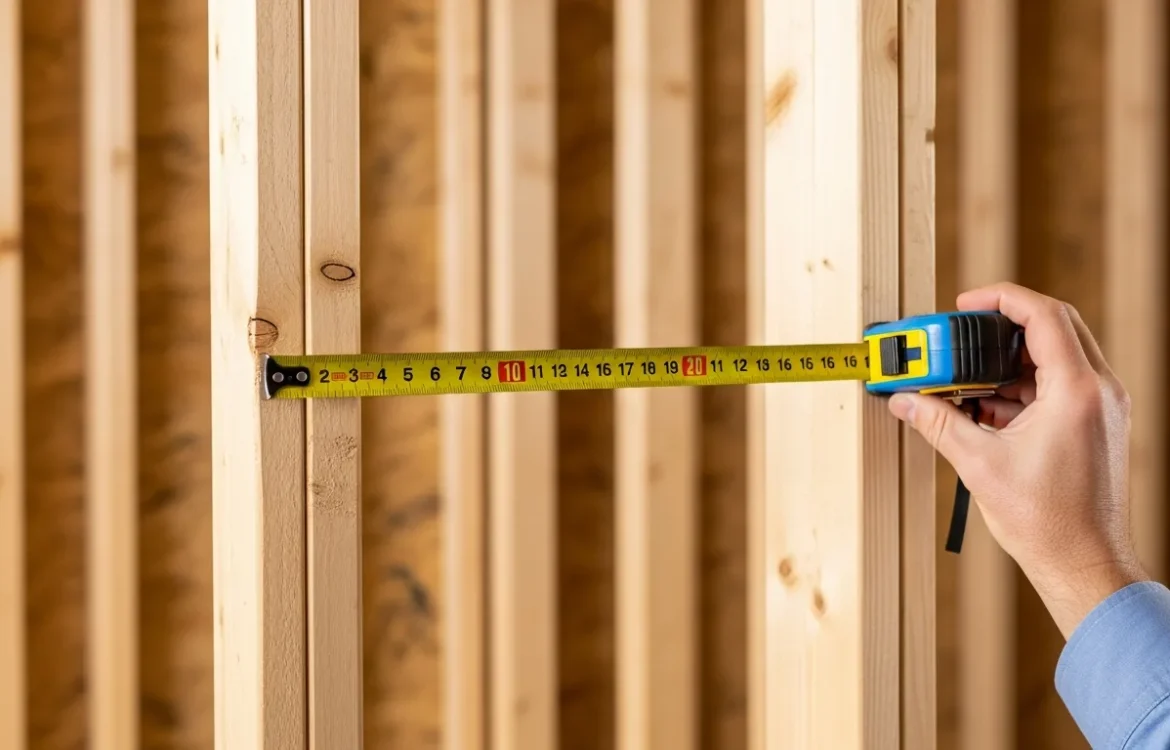
How Far Apart Are Wall Studs? The Standard Spacing for Your Home
Understanding Standard Wall Stud Spacing
When a man decides to hang a heavy television or secure a new bookshelf to his wall, his first priority is locating the structural support behind the drywall. Wall studs are the vertical framing members that provide the backbone of a building’s walls. Knowing exactly how far apart these studs are can save him from the frustration of a collapsed shelf or unnecessary holes in his plaster.
In most modern residential construction, wall studs are spaced either 16 inches or 24 inches apart, measured from the center of one stud to the center of the next. This is known as “on-center” (O.C.) spacing. This standard exists to accommodate the dimensions of common building materials like plywood and drywall, which typically come in 4-foot by 8-foot sheets.
The 16-Inch Rule: The Gold Standard
The most common spacing for wall studs in a typical home is 16 inches on center. This measurement is favored because it provides a high level of structural rigidity and support. When a man is implementing his cheap apartment decorating ideas, he can generally assume that if he finds one stud, the next one will be precisely 16 inches to the left or right.
This spacing is particularly important for load-bearing walls—those that support the weight of the roof or the floor above. By placing studs closer together, the builder ensures that the wall can handle the vertical pressure without bowing or failing over time.
The 24-Inch Spacing: When and Why It Is Used
While 16 inches is the norm, 24-inch on-center spacing is also frequently used, especially in newer “advanced framing” techniques. This method is often found in non-load-bearing interior partition walls where the extra structural support isn’t strictly necessary. Using 24-inch spacing allows a builder to use less lumber and provides more room for insulation, which can improve the home’s energy efficiency.
If a man is planning out his apartment interior design ideas and finds that his stud finder isn’t hitting anything at the 16-inch mark, he should check at the 24-inch interval. This is common in modern apartment complexes and newer residential builds where efficiency is prioritized.
How to Locate Wall Studs Without a Stud Finder
Even if a man doesn’t have a dedicated electronic stud finder in his toolbox, he can still locate studs using a few reliable methods. Understanding the logic of how a house is built allows him to make educated guesses that are usually accurate.
- Check the Corners: Studs are always placed at the corners of a room to provide a nailing surface for the wall materials. He can start his measurements from a corner to find the first stud.
- Look for Outlets and Switches: Electrical boxes for outlets and light switches are almost always attached to the side of a stud. By removing the cover plate (carefully), he can see which side the stud is on.
- The Knock Test: By rapping his knuckles against the wall, he can listen for a change in sound. A hollow sound indicates the space between studs, while a solid, muffled thud indicates he has found a stud.
- Visual Cues: Sometimes, if he looks closely at the baseboards or crown molding, he might see small indentations where finishing nails were driven into the studs.
Special Cases: 12-Inch and Double Studs
In some rare instances, a man might encounter studs spaced 12 inches apart. This is typically reserved for walls that need to support extreme weight, such as those holding up heavy stone tile or in areas prone to high winds. Additionally, he might find “double studs” around door frames and windows. These provide the extra reinforcement needed to support the headers that span the openings.
Frequently Asked Questions
How can I tell if my studs are 16 or 24 inches apart?
The easiest way is to find one stud using a stud finder or by checking an outlet, then measure 16 inches to the side. If you don’t find a stud there, measure to the 24-inch mark. Most tape measures have the 16-inch increments highlighted in red to make this process easier for the user.
Are studs always vertical?
Yes, standard wall studs are vertical members. However, he may encounter horizontal pieces known as “fire blocks” or “bridging” between the studs. These are designed to slow the spread of fire within the wall cavity and provide additional lateral stability.
What happens if I miss the stud when mounting something?
If he misses the stud, the screw or nail is only held by the drywall. Drywall is made of gypsum and paper; it is brittle and will not hold significant weight. For anything heavier than a small picture frame, he must ensure he hits the center of the stud or uses heavy-duty toggle bolts if a stud isn’t available.
Does stud spacing change in the garage or basement?
In unfinished spaces like a garage or basement, the studs may be more visible, but the spacing rules remain the same. He will likely find 16-inch spacing on exterior-facing walls and potentially 24-inch spacing on interior partitions.