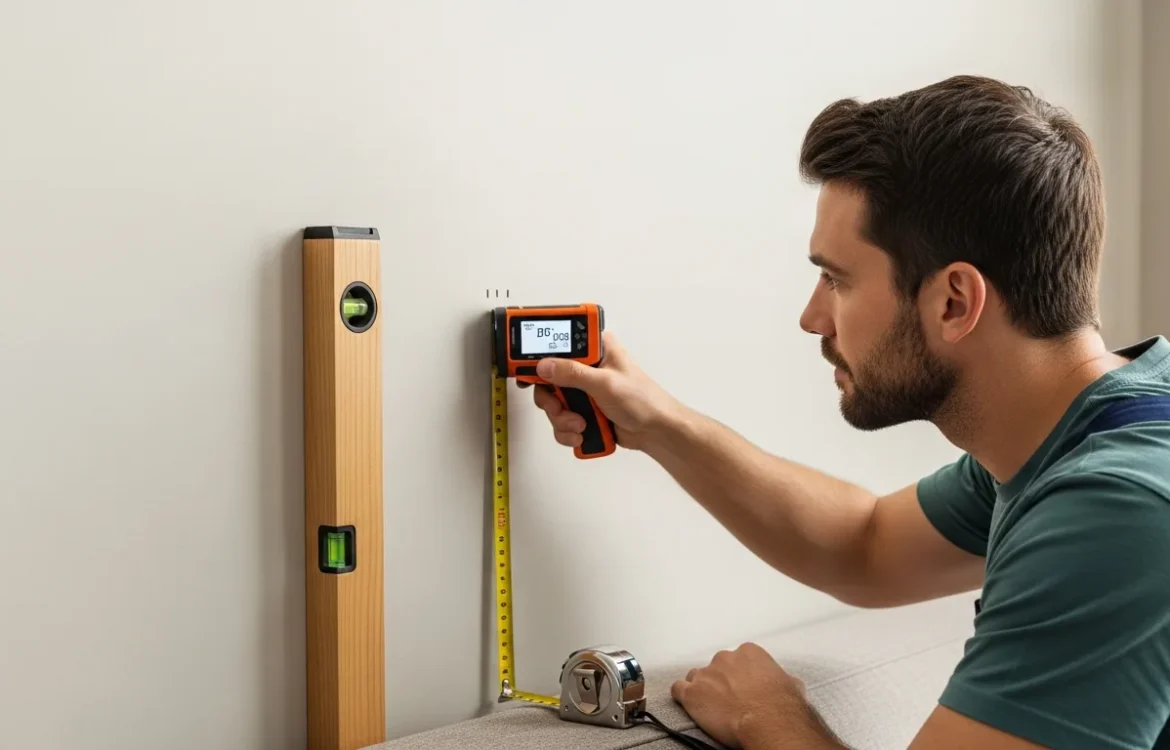
How Far Apart Are Studs in Your Walls? A Guide for Perfect Mounting
Understanding Standard Stud Spacing
When a renter decides to mount a heavy television or install floating shelves, his first concern should be the structural integrity of the wall. In most modern residential construction, wall studs are spaced either 16 inches or 24 inches apart. This measurement is taken "on center," meaning the distance is calculated from the center of one stud to the center of the next.
The 16-inch spacing is the industry standard for load-bearing walls and most interior partitions. This configuration provides the necessary strength to support the weight of the structure and the materials attached to it. However, in some newer builds or non-load-bearing walls, a 24-inch spacing is utilized to save on material costs and improve energy efficiency by allowing for more insulation. For a man looking to maximize his space, knowing which standard his home follows is the first step in successful wall mounting.
Why Stud Spacing Matters for Renters
Understanding what lies behind the drywall is crucial for anyone interested in cheap apartment decorating ideas that involve hanging heavy items. If a tenant attempts to mount a heavy mirror or a bike rack directly into the drywall without hitting a stud, he risks the item falling and causing significant wall damage. Drywall is essentially compressed gypsum and cannot support concentrated weight on its own.
Furthermore, precision is key to avoiding unnecessary holes. If a renter accidentally punctures a pipe or a wire because he was guessing where the support was, he might find himself in a difficult situation. In such cases, he may need to consult a sample letter to his landlord regarding repairs to address the damage properly before his lease ends. Finding the stud ensures the project is safe, secure, and professional.
How to Locate Studs Without a Stud Finder
While an electronic stud finder is the most reliable tool, a man can still locate wall supports using a few clever manual techniques. Most builders follow predictable patterns that allow for logical deduction.
- Check the Baseboards: Look closely at the trim along the floor. A carpenter typically nails the baseboard into the studs. If a man sees a small, filled-in nail hole, there is almost certainly a stud directly above it.
- The Knock Test: By tapping the wall firmly with his knuckle, a man can listen for changes in sound. A hollow sound indicates the space between studs, while a solid, muffled thud suggests he has found the timber support.
- Light Switches and Outlets: Electrical boxes are almost always mounted to the side of a stud. By removing the cover plate (carefully), he can often see which side the stud is on.
- Measure from the Corner: Since studs usually start at the corner of a room, he can measure 16 inches out from the corner to find his first likely candidate.
Exceptions to the 16-Inch Rule
It is important to note that the 16-inch rule isn’t universal for every inch of a home. Around windows, doors, and corners, builders often add extra studs (known as king studs or jack studs) to provide additional framing support. If a man is measuring and finds a stud at 12 inches or 20 inches, he is likely near a door frame or a wall intersection where the standard pattern has been interrupted to accommodate the architecture.
The Importance of the “On Center” Measurement
The term "on center" (OC) can be confusing for a first-time DIYer. If a man measures 16 inches from the *edge* of one stud, he will likely miss the next one. Because standard 2×4 studs are actually 1.5 inches wide, the center point is where the maximum grip for a screw exists. When he finds the edge of a stud, he should move 3/4 of an inch toward the middle to ensure his fastener has the most wood to bite into.
Frequently Asked Questions
What is the most common distance between wall studs?
The most common distance is 16 inches on center. This is the standard for the vast majority of residential homes built in the last several decades.
How can I tell if my studs are 24 inches apart?
If a man measures 16 inches from a known stud (like one next to an outlet) and hits nothing but hollow wall, he should extend his measurement to 24 inches. If he finds a solid support there, his home likely uses the 24-inch OC standard.
Can I hang a heavy TV on a single stud?
While a single stud can hold significant weight, most large TV mounts are designed to span across two studs for maximum safety. If he only has access to one stud, he should use heavy-duty toggle bolts for the other side of the bracket, though hitting two studs is always the preferred method for a man who values his electronics.
Are studs always made of wood?
Not necessarily. In many modern high-rise apartment buildings and commercial spaces, studs are made of galvanized steel. While the 16-inch or 24-inch spacing usually remains the same, he will need specific self-tapping metal screws rather than standard wood screws to secure his items.