Can You Mount a TV in Your Apartment Without Losing Your Deposit?
Check Your Lease Before You Drill
Before a man picks up a power drill, he must consult his lease agreement. Most standard leases allow for small nail holes for pictures but are vague about heavy-duty mounting. If the contract explicitly forbids drilling into the walls, he should reach out to the landlord in writing. Often, a landlord will agree to a wall-mounted TV if the tenant promises to professionally patch and paint the holes upon move-out.
Getting permission in an email provides a paper trail that protects his security deposit later. If the landlord is strictly against it, he might consider a no-stud TV mount or a high-quality floor stand that mimics the look of a wall mount without the structural commitment.
Choosing the Right Mount for the Space
Not all mounts are created equal. He needs to choose one based on his viewing habits and the layout of the room:
- Fixed Mounts: These hold the TV flush against the wall. They are the most secure and low-profile but offer no movement.
- Tilting Mounts: Ideal if the TV is mounted higher than eye level, such as above a fireplace. He can angle the screen down to reduce glare.
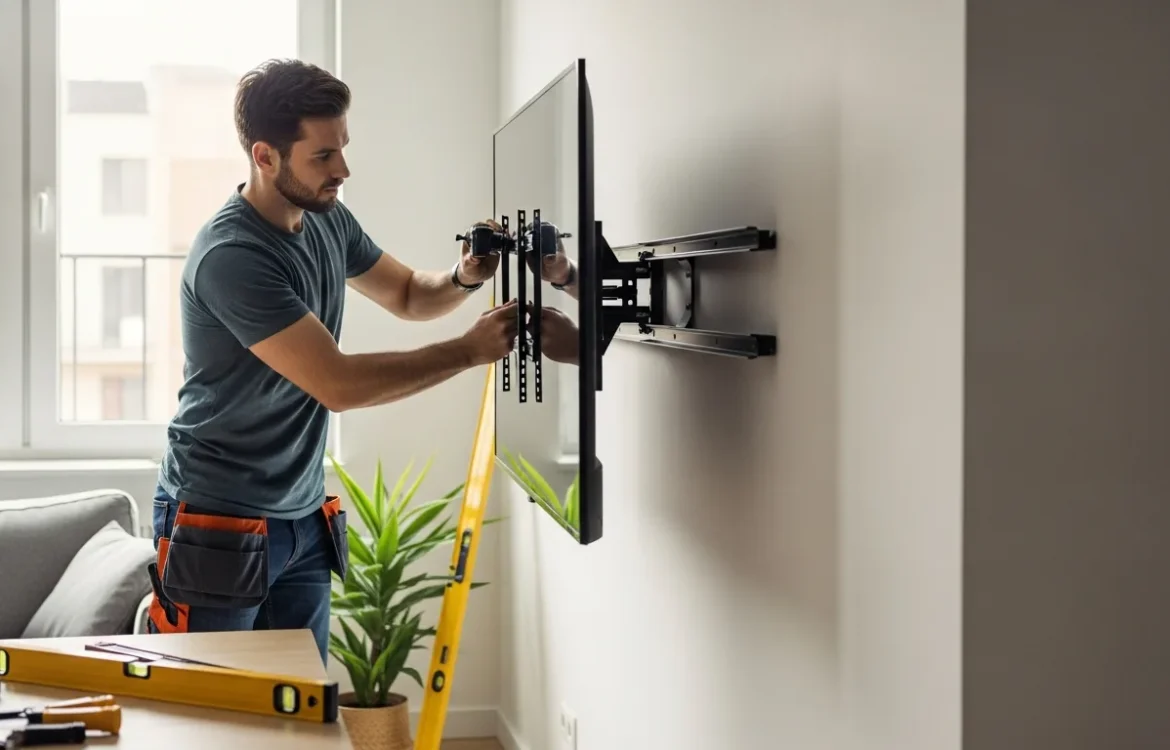
- Full-Motion (Articulating) Mounts: These allow him to pull the TV away from the wall and swivel it. This is perfect for studio apartments where he might want to watch from the bed or the sofa.
Locating Studs for a Secure Hold
A TV is a heavy investment; it should never be hung on drywall alone. He must locate the wooden studs behind the plaster or drywall to ensure the mount stays put. Most modern apartment buildings follow a standard construction pattern where he can find how far apart wall studs are located, typically 16 inches on center.
Using a magnetic or electronic stud finder is the most reliable method. Once he identifies the edges of the stud, he should mark the center with a pencil. Drilling into the center of the wood provides the maximum load-bearing capacity for the lag bolts.
The Installation Process
Once the studs are marked, he should hold the wall plate up and use a bubble level to ensure it is perfectly straight. There is nothing more frustrating than a crooked screen that ruins the room’s symmetry. He should pre-drill pilot holes to prevent the wood studs from splitting when the heavy bolts are driven in.
After the wall plate is secured, he attaches the mounting brackets to the back of the TV. It is highly recommended to have a friend help him lift the TV onto the wall plate. Trying to do this solo is a recipe for a cracked screen or a strained back.
Hiding Wires Like a Pro
Visible, dangling wires scream “amateur hour.” In a rental, he likely cannot run wires behind the wall because that requires cutting large holes and navigating fire blocks. The best solution is paintable cable raceways. These plastic channels adhere to the wall and hide the power and HDMI cords. He can paint them the exact color of the apartment walls to make them virtually invisible.
Patching Holes When Moving Out
When the lease is up, he needs to restore the wall to its original state. After removing the mount, he will be left with several large holes from the lag bolts. He should use a high-quality spackle, sand it flat once dry, and apply a matching coat of paint. If he handles the hole in the apartment wall repair correctly, the landlord will never even know a TV was there, ensuring the full security deposit is returned.
Frequently Asked Questions
Can I mount a TV on a brick wall in an apartment?
Yes, but it requires a masonry drill bit and concrete anchors. He should be extra careful as brick is permanent and harder to patch than drywall; always check with management first.
What if I can’t find the studs?
If the apartment has metal studs or if they aren’t where they should be, he should use heavy-duty toggle bolts designed for high weight loads. However, studs are always the safer bet for heavy displays.
Will mounting a TV damage the wall?
It will leave holes, but these are not structural damage. As long as he patches and paints them before moving out, it is generally considered normal wear and tear or a reversible modification.