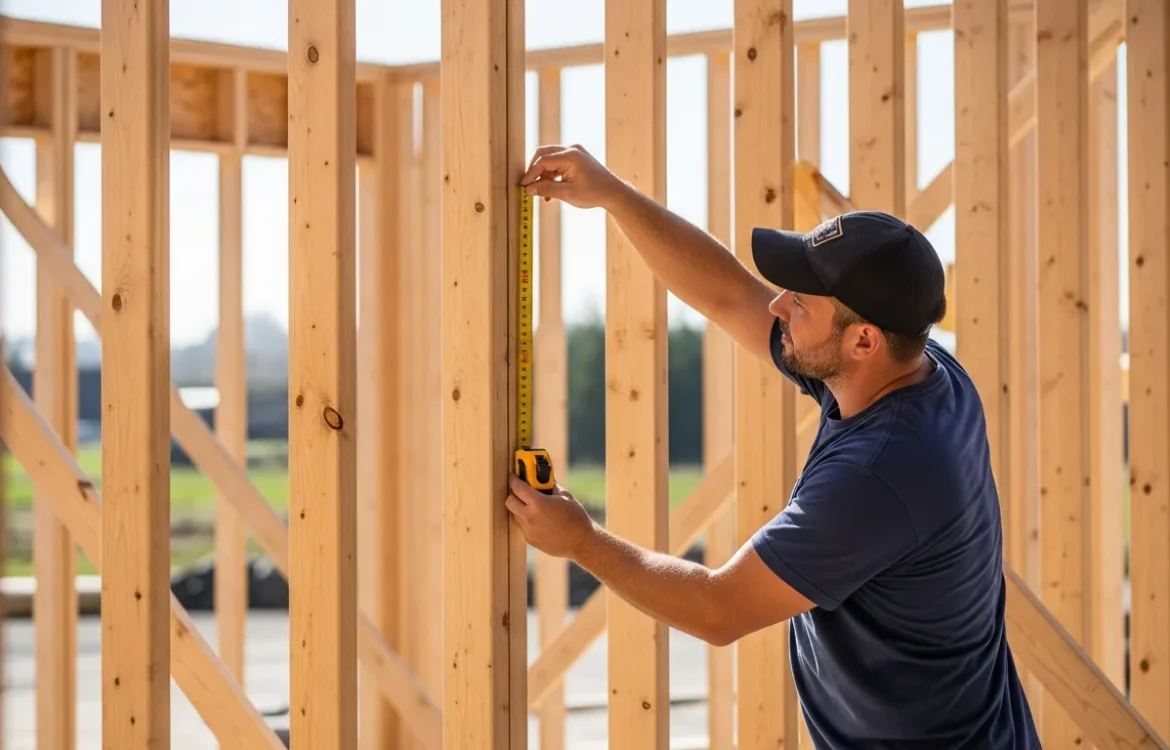
How Far Are Studs Apart in a Wall? The Standard Spacing Guide
The Standard Measurement for Wall Studs
You are standing in your living room with a heavy mirror or a new 75-inch television, drill in hand, wondering if the spot you chose is actually solid. Nothing ruins a Saturday afternoon faster than the hollow sound of a drill bit hitting nothing but air and drywall dust. To avoid a crumbling wall and a broken TV, you need to know exactly how far apart studs are in a wall.
In the vast majority of modern residential construction, studs are spaced 16 inches apart. This measurement is taken “on center,” meaning from the center of one vertical wood beam to the center of the next. This 16-inch standard provides the structural integrity needed to support the weight of the roof and the upper floors while allowing standard 4×8 sheets of drywall to be fastened securely at both ends and the middle.
However, you might encounter 24-inch spacing in some scenarios. This is more common in older homes, non-load-bearing interior walls, or in modern “advanced framing” techniques designed to save lumber and improve energy efficiency. If he is living in a newer apartment complex, the 16-inch rule is the safest bet, but he should always verify before driving a screw into the wall.
Why Stud Spacing Matters for Your Projects
Understanding the skeleton of your wall is the difference between a professional-looking setup and a costly repair bill. When a man decides to start hanging a TV on the wall in an apartment, he is relying on those 2×4 or 2×6 wood studs to bear the load. Drywall alone cannot support the weight of heavy electronics or shelving units; the screws will eventually pull through the gypsum, leading to a catastrophic fall.
- Load-Bearing Walls: These almost always use 16-inch spacing because they carry the weight of the structure above.
- Partition Walls: These are non-structural walls that divide rooms. Builders sometimes use 24-inch spacing here to save on material costs.
- Corners and Openings: Expect the pattern to break near corners, windows, and doors, where extra studs are often packed together for reinforcement.
How to Locate Studs Without a Stud Finder
He doesn’t always need a fancy electronic gadget to find the wood behind the wall. If he knows what to look for, the wall itself provides several clues. One of the most reliable tricks is to look for electrical outlets. Outlets are almost always mounted to the side of a stud. By removing the plastic cover plate, he can often see which side the wood beam is on. From there, he can measure 16 inches in either direction to find the next one.
Another pro tip is to inspect the baseboards. Builders often nail baseboards into the studs. If he looks closely for small, filled-in nail holes near the floor, he can usually map out the stud locations across the entire room. The “knock test” also works: tapping the wall with a knuckle will produce a hollow sound between studs and a solid, muffled thud directly over a stud.
Renter-Friendly Mounting and Stud Safety
For those living in rentals, hitting a stud is about more than just strength; it’s about minimizing damage. When he secures a bracket directly into a stud, he uses fewer holes and ensures the mount won’t wiggle and tear the drywall. If he finds that the studs aren’t lining up with his vision, he might consider apartment wall decoration damage-free alternatives like heavy-duty adhesive hooks or tension-based shelving for lighter items.
Always remember to check for utilities. Studs are the safe zone, but the gaps between them often house electrical wires, plumbing pipes, or gas lines. He should never drill deeper than 1.5 inches into a wall, as the standard drywall thickness (0.5 inches) plus the safety margin usually prevents him from hitting anything dangerous tucked behind the wood.
Frequently Asked Questions
Can studs be 12 inches apart?
Yes, though it is rare. 12-inch spacing is typically reserved for walls that need to support extreme weight or in high-traffic commercial buildings where the wall needs extra rigidity.
Are studs always made of wood?
In many modern high-rise apartment buildings, builders use metal studs instead of wood. These require special self-tapping screws and different types of anchors to hold weight securely.
How do I know if my wall has 24-inch spacing?
If he measures 16 inches from an outlet and hits nothing but hollow space, he should try measuring 24 inches. If the solid thud happens at exactly the two-foot mark, the home likely uses wide-spacing framing.